Template agent workflows
This section introduces template workflows, also known as workflow agents, which are specialized agents that control the execution flow of one or more sub-agents. Template workflow agents are specialized components designed for orchestrating the execution flow of sub-agents. Their primary role is to manage how and when other agents run, defining the control flow of a process.
Alternative: graph-based workflows
Starting in ADK 2.0, template workflows have been superseded
by more flexible workflow structures, including graph-based workflows and dynamic workflows. These workflow architectures provide more control, flexibility and capability to evolve your agent workflows over time.
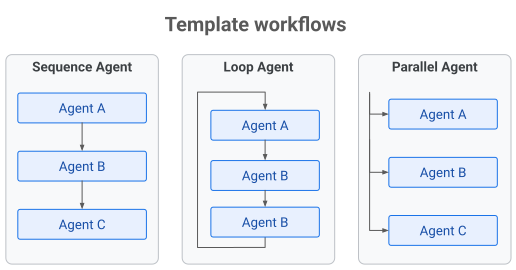
Figure 1. Execution patterns of template workflows in ADK
Template workflow agents operate based on predefined logic. They determine the execution sequence according to their type, such as sequential, parallel, or loop, without consulting an AI model for assistance with the orchestration. This approach results in deterministic and predictable execution patterns. Template workflows include the following task execution structures, which each implement a distinct task completion pattern:
-
Sequential Agent workflow
Executes sub-agents one after another, in sequence.
-
Loop Agent workflow
Repeatedly executes its sub-agents until a specific termination condition is met.
-
Parallel Agent workflow
Executes multiple sub-agents in parallel.